


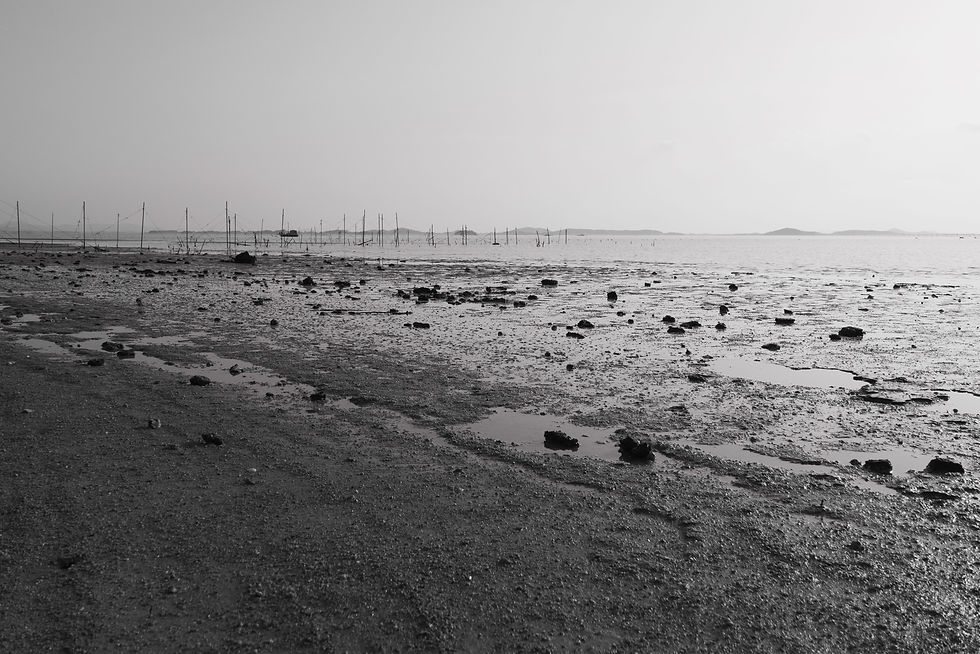
The Challenge
At first glance, a sandflat looks empty. Just sand, water, and sky. Yet beneath the surface lies a vital ecosystem that stores carbon, filters water, and keeps estuaries in balance. Research shows that sediment in tidal flats like these is one of the most important carbon reservoirs on Earth, comparable to habitats such as mangroves, salt marshes, and seagrasses.
The problem is that sandflats rarely get attention. Few people know much about them or even realise how important they are. The challenge is how to bring this hidden world to people so they can truly experience it. As David Attenborough has said, “No one will protect what they do not care about, and no one will care about what they have never experienced.”


Augmented Reality Poster
-
Augmented reality poster
-
Accessibility friendly
-
Based on real world research
Augmented Reality Poster
-
Augmented reality poster
-
Accessibility friendly
-
Based on real world research
CASE STUDY: Sandflat Heroes
Making the Invisible Visible
Sandflat Heroes is an augmented reality app developed with the New Zealand Marine Discovery Centre in Leigh and the University of Auckland. By scanning a poster or outdoor frame, players unlock a 3D cross section of sand where hidden creatures spring to life with facts and animations. Crabs burrow through the sediment, shellfish filter and clean the water, and bamboo worms push sediment around, bringing oxygen deep into the sand. Each of these creatures is a tiny engineer, working together to keep estuaries healthy and life in balance.

Project Outcomes
Ecosystem literacy
The sandflat creatures quietly provide the services that make estuaries safe, clean, and rich with life, and are the very systems that support us too. By learning to read these signs of life, players build a working understanding of how estuarine ecosystems function.
Real-world connection
Sandflat Heroes encourages people to take what they discover in the app back to the beach. Once you know what to look for, you start to notice the tiny signs of life everywhere: the trails left behind by worms, the siphon holes of cockles and macomona, the tracks of whelks, or the delicate patterns made by spionid worms.
"Sandflat Heroes gives people who are more experiential learners, the chance of being able to play with something, mess with it, to see a connection into the real world. It is is a really powerful way of learning."
Prof. Simon Thrush - Director, Institute of Marine Science at The University of Auckland


Resources & Associated Papers
Ladewig, S. M., Bianchi, T. S., Coco, G., Ferretti, E., Gladstone-Gallagher, R. V., et al. (2024). Polyester microfiber impacts on coastal sediment organic matter consumption. Marine Pollution Bulletin, 202, 116298. https://doi.org/10.1016/j.marpolbul.2024.116298
Schenone, S., Hewitt, J. E., Hillman, J., Gladstone-Gallagher, R., Gammal, J., et al. (2025). Seafloor sediment microtopography as a surrogate for biodiversity and ecosystem functioning. Ecological Applications, 35(1), e3069. https://doi.org/10.1002/eap.3069
Siwicka, E., Gladstone-Gallagher, R., Hewitt, J. E., & Thrush, S. F. (2021). Beyond the single index: Investigating ecological mechanisms underpinning ecosystem multifunctionality with network analysis. Ecology and Evolution, 11(18), 12401-12. https://doi.org/10.1002/ece3.7987
Thrush, S. F., Townsend, M., Hewitt, J. E., Davies, K., Lohrer, A. M., Lundquist, C., & Cartner, K. (2013).
The many uses and values of estuarine ecosystems. In J. R. Dymond (Ed.), Ecosystem services in New Zealand: Conditions and trends (pp. 226–237). Manaaki Whenua Press. https://www.landcareresearch.co.nz/assets/Publications/Ecosystem-services-in-New-Zealand/1_16_Thrush.pdf
Thrush, S. F., Hewitt, J. E., Parkes, S., Lohrer, A. M., Pilditch, C., Woodin, S. A., et al. (2014).
Experimenting with ecosystem interaction networks in search of threshold potentials in real-world marine ecosystems. Ecology, 95(6), 1451–1457. https://doi.org/10.1890/13-1879.1
Lohrer, A. M., Thrush, S. F., Hewitt, J. E., & Kraan, C. (2016).
Functional trait diversity of marine macrofauna and ecosystem functioning: Current knowledge and future directions. In C. Kraan (Ed.), Zostera ecotones. ScienceDirect. https://www.sciencedirect.com/science/article/abs/pii/S0272771416303006